


“I would like you to share your green moments with each other” I invite to the 250 members of the auditorium. The room begins to buzz with noise as the audience comes alive. Faces instantly show interest, engagement and curiosity. As the conversations flow, there are agreeable nods and smiles, and plenty of enthusiastic “Ohh, that was one of mine” and “me too” statements. There is also the occasional frown followed by a surprised “really”.
So, what are these “green moments” that immediately and effortlessly sparked conversations in a lecture theatre where getting participants to talk with one another is usually like getting blood from a stone? The 250 participants had just completed a ResilienceLab 360 with the Centre for Resilience. Part of the program included participants wearing a monitor for three-days to measure their heart rate variability (HRV).1 HRV is a way to measure a person’s stress/activation and recovery response to daily life. They also kept a diary of their day to day activities. The report that people received matched the physiological data from their HRV with their contextual diary data. Stress and activation show up a red, and recovery show up as green.2
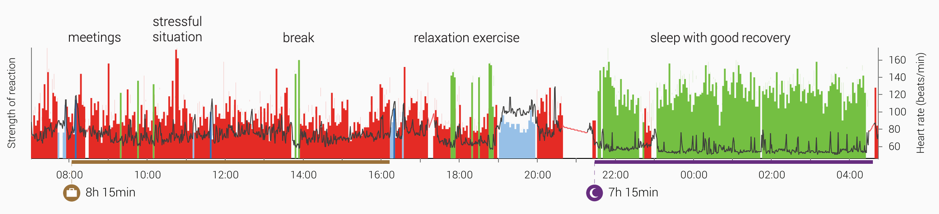
Generally speaking, the overwhelming colour on people’s reports is red. This is unsurprising as many of the clients we see start their days with their foot pressed hard to life’s accelerator pedal. They often don’t hit the brakes until they collapse into bed or self-medicate with solutions that might feel useful but are actually not solutions at all.
The participants in the auditorium were discussing their “green moments” from their reports and describing what it was that they were doing. There were the green moments you would expect from some activities such as gardening, mindfulness, reading, learning, listening to music and sharing time with loved ones. There were also some funny stories of people getting recovery whilst dancing like no one was watching to 1980’s pop in their kitchen; rocking out in their car and singing their favourite song full volume in a traffic jam; and watching YouTube cat videos on the train commute home.
The activities that provided the participants with their green recovery moments were diverse and sometimes quite unique. However, participants often reported a sense of pleasant surprise. These activities that people were doing in their lives that provided them with well needed physiological recovery were often viewed by the participants as frivolous, unimportant or a waste of time. In reality, these activities provided them with moments of wellbeing. They would report “I always feel good doing that…” and now their hearts were confirming that what they felt was real. “Seeing the data really helped me to confirm that writing in my diary is time well spent. I’m definitely going to continue” reported one participant. This was common feedback from the majority of the participants. The data about their ‘green’ recovery activities was a confirmation. More importantly, it was permission to continue, to keep doing what they loved and to find more time to prioritise those “frivolous” activities.
Their hearts had been their inner ally sending signals to a small device that interpreted the information via an algorithm and mapped it onto a report. Their hearts had told them what was helping with their recovery and wellbeing, it was as clear as red and green.
So, why had so many of them ignored this ally of their bodies in the past? The activities that brought them joy, connection, growth, purpose and meaning were often the first to be abandoned and forgotten when times were challenging. It can be hard to hear our inner ally over the noise of life. This is a common experience.
The monitoring helped people to listen; however, we already have a monitor that allows us to listen and hear. It is our bodies, our minds and our emotions. All too often people’s minds and bodies are hijacked. Should haves, could haves, overgeneralisations, catastrophising and other ideas can sabotage our thinking. Emotions can drive us in ways that are unhelpful for the situation.
We often treat the inner ally of our bodies as an enemy that needs to keep quiet and shut up so we can get on with things. If we treated ally’s in our social or work circles the way we so often treat ourselves, our allegiances would quickly fracture.
So how might we learn to listen to our often-fractured internal inner ally? Learning to be self-compassionate can help in this journey. Research shows that treating oneself with care and compassion is a powerful way to enhance intrapersonal and interpersonal wellbeing.3
At that moment in that auditorium 250 people shared and listened to each other’s wellbeing practices with curiosity, connection and compassion for each other and more importantly compassion for themselves.
References
[1] Firstbeat Technologies Ltd. (2014). Stress and recovery analysis method based on 24-hour heart rate variability. Retrieved 01 October, 2020, from https://www.firstbeat.com/en/stress-recovery-analysis-method-based-24-hour-heart-rate-variability-firstbeat-white-paper-2/
[2] Föhr, T., Tolvanen, A., Myllymäki, T., Järvelä-Reijonen, E., Peuhkuri, K., Rantala, S., Kujala, U. (2017). Physical activity, heart rate variability–based stress and recovery, and subjective stress during a 9-month study period. Scandinavian Journal of Medicine and Science in Sports, 27 (6), 612-621. doi:10.1111/sms.12683
[3] Neff, K. D., & Costigan, A. P. (2014). Self-Compassion, Well-Being, and Happiness. Psychologie in Österreich, 2, 114-119
